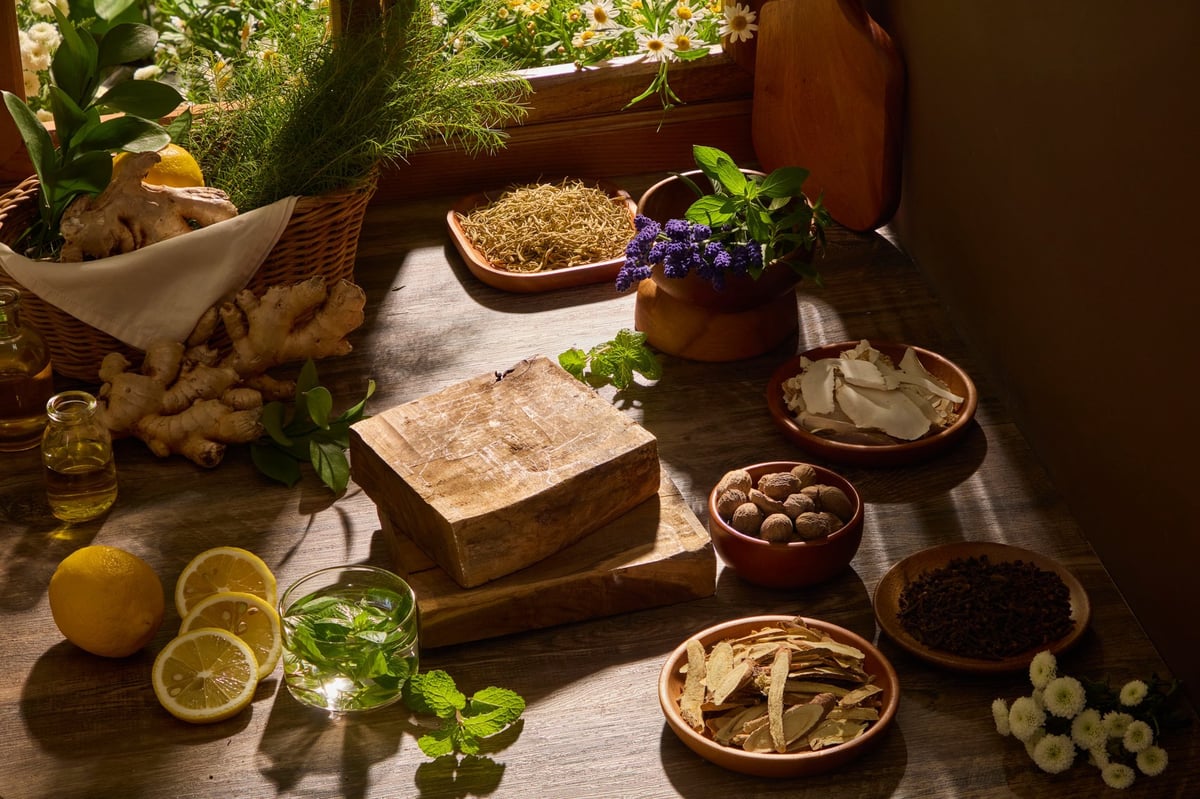
Long before clinical trials and peer-reviewed journals, human beings discovered the healing power of plants through observation, trial and error, and generations of accumulated wisdom. Today, modern science is not replacing this ancient knowledge — it is validating it, explaining the biochemical mechanisms behind remedies that have worked for thousands of years.
Ayurveda, India's traditional medical system, has used the four herbs in MoLivite for millennia. Moringa (Shigru) was prescribed for over 300 conditions in Ayurvedic texts. Turmeric (Haridra) was considered a sacred plant used for purification and healing. Ginger (Adrak) was a cornerstone of digestive and respiratory health. Each of these uses is now backed by modern research identifying the specific active compounds — curcumin in turmeric, gingerols in ginger, isothiocyanates in moringa — that explain their traditional applications.
TCM has used ginger for over 2,000 years as a warming herb that supports the body's defensive Qi — essentially, the immune system. Turmeric (Jiang Huang) was used to invigorate blood circulation. The TCM concept of synergistic herbal formulas — combinations designed to enhance each herb's benefits while reducing side effects — mirrors what modern pharmacology now calls "polypharmacology."
Moringa is native to the Himalayan foothills but has been a cornerstone of African traditional medicine for centuries. In Nigeria, it is called "Zogale" and used for everything from nutritional support to immune enhancement. In Ethiopia, Moringa leaves are used to support lactating mothers. Ghanaian traditional practitioners have long used Moringa for blood sugar support — a use now confirmed by multiple clinical trials showing Moringa's beneficial effects on glucose metabolism.
Olive leaf has been used in Mediterranean folk medicine since ancient Egypt, where it was considered a symbol of heavenly power. Ancient Greek physicians prescribed olive leaf preparations for fevers and infections. What they could not have known was that oleuropein — the compound responsible for olive leaf's bitter taste — is a powerful antimicrobial and antioxidant with broad health benefits now confirmed by modern research.
The Modern Validation
Today, over 40% of pharmaceutical drugs are derived from natural compounds originally discovered in plants. Aspirin came from willow bark. Metformin came from French lilac. The line between "herbal medicine" and "modern medicine" is far blurrier than most people realize — and the plants in MoLivite sit squarely at this intersection of ancient wisdom and cutting-edge science.
What makes this evolution so powerful is that modern science does not invalidate traditional knowledge — it refines it. We now know exactly which compounds in Moringa support immune function, precisely how curcumin modulates inflammation, and specifically what dose of oleuropein produces clinical benefits. Traditional medicine gave us the "what" — modern science gives us the "how" and "how much."
MoLivite combines four herbs with thousands of years of traditional use — now validated by modern clinical research.
Shop MoLivite